Hey Moyeesta,
Our tour guide Guido was back in Ethiopia.
To visit coffee farmers, catch up with our teams, and see how things are going with our coffee, our forests, and our plans.
But first, he still had to actually get into the country — and that turned out to be a little more complicated than expected.
His new passport was linked to his old visa. So: apply again. Pay again. Arrange new documents. Wait. And wait some more.
After two days at Addis Airport, he was starting to feel more like Tom Hanks in The Terminal than the founder of a coffee company.
Luckily, we have an amazing team in Ethiopia. While he was stuck waiting at the airport, they spent days driving from office to office to get all the documents sorted again.
Eventually, it worked. And then the real journey could begin.
Guido on
“the front line”
After a long drive, I arrived at a place that is literally on the front line of deforestation. Look at the photo below. On the left: giant trees that were cut down and burned only recently. On the right, just a few meters away: the exact same trees, still alive.
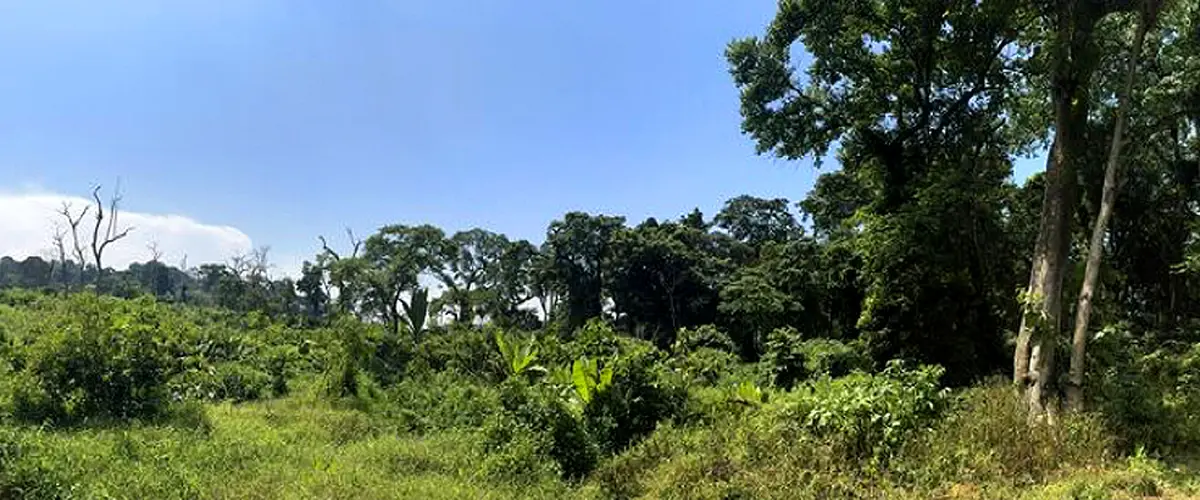
One river in between, but two completely different futures. It made me think of the Maginot Line. Except this one doesn’t stand between France and Germany — it stands between deforestation and regeneration. And behind that lies an uncomfortable truth that, after ten years of FairChain, we understand better and better: poverty is a driver of deforestation.
We talk a lot about climate change and coffee. Rightly so.
But we talk much less about the other side of the story. If a farmer doesn’t earn enough to make a living from agriculture, an ancient tree suddenly has a price: as firewood, timber, or extra farmland.
So it disappears. And then the bill arrives: more extreme rainfall, more erosion, poorer soil, lower coffee yields… not exactly a great business case.
So: plant more trees? Absolutely. But that’s not enough. Because you can plant a thousand trees today and lose them again tomorrow if a farmer still can’t earn a decent income.
That’s why we do things differently. We work with coffee farmers on “regenerative agroforestry.” Put simply: combining coffee with mango, avocado, pepper, and native shade trees. Less dependence on a single crop. More income. More biodiversity. More resilience. More forest!
And here’s the interesting part: helping a farming family make this transition costs around €200. With that, you can help a family build a farming system that creates multiple income streams and protects the forest at the same time. That’s not charity — it’s simply a very strong business case.
The conclusion: the opposite of deforestation is not a tree. It’s a farmer who can earn a decent living.
Because when a forest is worth more standing than it is cut down, protecting it suddenly makes economic sense.
And yet, smallholder farmers around the world receive less than 1% of climate finance. Less than 1%. While they produce roughly a third of our food and are right in the middle of the climate crisis.
We pour billions into climate solutions, but the people standing on the front line every single day barely have access to that money. That’s crazy, right?
That’s why I increasingly find myself asking: why do we keep financing one-off projects when we could build revolving funds that can be reinvested again and again?
A FairChain Forest & Farmers Fund, for example. A healthy return on capital. A huge win for farmers, forests and the future. Makes sense, right? 😉
The original Maginot Line had one problem: it stood still. Ours doesn’t. It grows, every season, with every farmer and every tree.
My next Founder’s Note will be about the farmers behind our coffee. They are the real front line.
Every sip counts,
Guido